
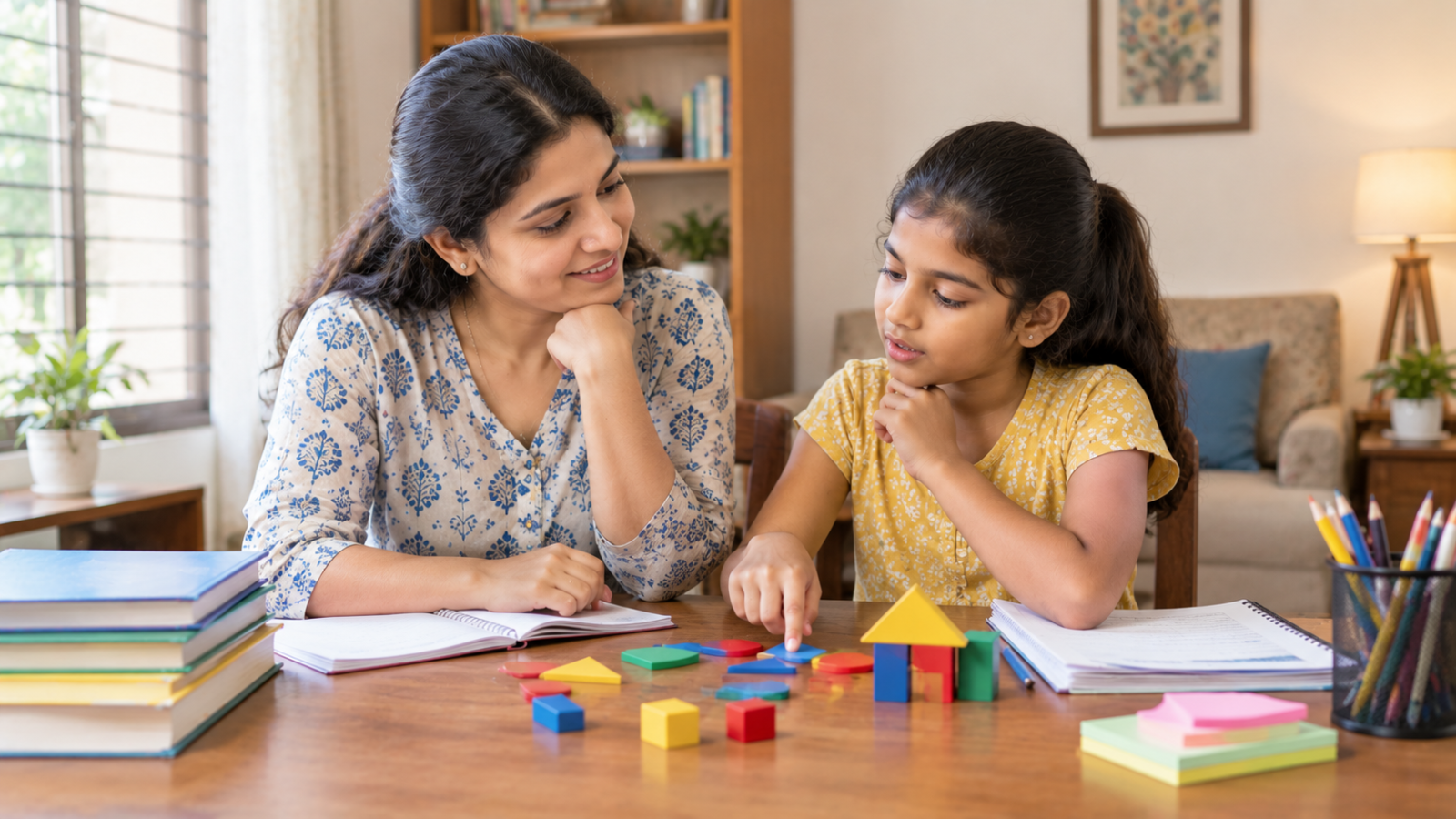
Quick answer: To encourage critical thinking in school-age children, help them ask questions, examine evidence, compare ideas and explain their reasoning instead of simply memorising answers. Parents and teachers can build these skills through everyday conversations, reading, puzzles, practical experiments and age-appropriate problem-solving activities. The goal is to help children think independently while remaining curious, respectful and open to learning.
What Is Critical Thinking in School-Age Children?
Critical thinking is the ability to examine information, ask meaningful questions, identify patterns, consider different explanations and reach a reasoned conclusion. It helps children understand not just what an answer is, but why that answer makes sense.
For example, when a child solves a Mathematics problem, critical thinking involves choosing a suitable method and explaining why it works. When reading a story, it may involve considering why a character behaved in a particular way or whether another explanation is possible.
These skills develop gradually. Younger children may begin by sorting objects and explaining simple choices, while older students can compare evidence, recognise assumptions and evaluate arguments. Adults can support this development by creating opportunities to think rather than expecting immediate, perfect answers.
Why Is Critical Thinking Important for Children?
Children encounter information from textbooks, conversations, advertisements, videos and digital platforms. Critical thinking helps them make sense of what they encounter instead of accepting every statement without consideration.
Encouraging critical thinking can help children:
- Solve problems: Break a difficult task into manageable steps and explore possible solutions.
- Become independent learners: Identify what they understand, recognise gaps and decide what to investigate next.
- Understand school subjects: Connect concepts with real-life examples instead of relying only on memorisation.
- Make thoughtful decisions: Compare options and consider possible consequences.
- Communicate clearly: Explain their ideas and listen to different viewpoints.
- Evaluate information: Ask whether a claim is supported by reliable evidence.
Critical thinking does not mean questioning everything for the sake of argument. It means learning to think carefully, recognise uncertainty and change one's opinion when stronger evidence becomes available.
1. Ask Open-Ended Questions Every Day
One of the simplest ways to develop critical thinking is to ask questions that require more than a yes-or-no answer. Open-ended questions encourage children to explain their thoughts, consider possibilities and connect ideas.
Instead of asking only, "Did you understand the chapter?", try questions such as:
- Why do you think this happened?
- How did you reach that answer?
- What evidence supports your idea?
- Can you think of another way to solve this problem?
- What might happen if one condition changed?
- What information would help you decide?
For example, after reading a story, ask your child why a character made a particular decision. Invite them to support their explanation with details from the story, and then consider whether another interpretation is possible.
Give children enough time to think before answering. If they struggle, offer a small hint rather than immediately providing the solution. This allows them to practise reasoning while knowing that support is available.
2. Encourage Children to Explain Their Reasoning
Getting the correct answer is useful, but understanding how a child reached it is equally important. Ask them to describe their steps, explain their choices and identify what they would do differently next time.
Use everyday schoolwork as an opportunity
In Mathematics, ask a child to demonstrate two ways of solving a problem. In Science, invite them to explain why they expect an experiment to produce a particular result. In English, ask them to support an interpretation of a passage with evidence.
If the answer is incorrect, avoid immediately labelling it as careless or foolish. Ask the child to revisit the steps and locate where their reasoning may have changed direction.
Teaching tip: Praise the effort involved in examining a problem, checking evidence and correcting mistakes. Children should learn that changing an answer after discovering new information is a positive part of thinking.
3. Use Puzzles, Games and Hands-On Activities
Children often practise reasoning naturally when they are solving an interesting challenge. Choose activities that require planning, pattern recognition, experimentation or decision-making rather than relying only on speed.
- Puzzles and riddles: Encourage children to identify clues and test possible answers.
- Building activities: Ask them to design a bridge or tower using simple household materials and explain what makes it stable.
- Strategy games: Invite them to plan their next move and consider how another player might respond.
- Sorting challenges: Ask younger children to group objects by different properties and explain their choices.
- Prediction games: Ask what might happen next in a story or practical activity and why.
After the activity, discuss which strategies worked and what could be changed. Keep the emphasis on reasoning and discovery rather than winning every game.
4. Connect Critical Thinking With Everyday Life
Children do not need special equipment or a formal lesson to practise critical thinking. Ordinary family routines provide opportunities to compare choices, estimate quantities, investigate problems and make decisions.
Examples parents can try at home
- While shopping: Compare package sizes, prices per unit and product information before deciding which option offers better value.
- While cooking: Ask what might happen if an ingredient or quantity changes, and discuss why following a sequence matters.
- While planning a trip: Compare travel options, expected time, weather and what the family needs to carry.
- While observing nature: Discuss why some leaves may look different or why shadows change during the day.
- While solving a household problem: Invite the child to suggest possible solutions and consider the advantages and disadvantages of each.
Allow children to participate in decisions that are appropriate for their age. Explain practical constraints when necessary, but give them a chance to contribute ideas and learn from the outcome.
5. Develop Critical Thinking Through Reading
Reading provides opportunities to examine characters, compare viewpoints, recognise cause and effect and distinguish facts from opinions. Stories, biographies, age-appropriate news articles and informational books can all support these skills.
While reading together, ask questions such as:
- What is the main idea of this passage?
- Which details support the author's explanation?
- Why might two characters understand the same event differently?
- Is this statement a fact, an opinion or a prediction?
- What additional information would help us understand the topic?
For older children, discuss whether an online claim is supported by evidence. Encourage them to check the source, look for relevant context and compare information with reliable references rather than judging a claim by its popularity alone.
For younger children, begin with simple stories and picture books. Ask them to predict what happens next and explain which clues helped them make that prediction.
6. Teach Children to Consider Different Perspectives
Critical thinkers understand that people may interpret the same situation differently. Encourage children to listen carefully, ask respectful questions and consider why someone else might hold a different opinion.
For example, after discussing a classroom rule or a character's decision, ask your child to explain the situation from another person's point of view. They can consider what information that person had and what concerns might have influenced the decision.
Explain that considering another perspective does not mean automatically agreeing with it. Children can evaluate competing arguments by examining the reasons and evidence each person provides.
Model this behaviour in your own conversations. Acknowledge when another person makes a useful point and show that it is acceptable to reconsider an opinion after learning something new.
7. Encourage Independent Problem-Solving
When children face a difficult task, adults may be tempted to step in immediately. However, solving every problem for them can reduce opportunities to practise independent thinking.
Instead, guide the child through a simple problem-solving process:
- Understand the problem: Ask the child to describe what needs to be solved.
- Identify what is known: Discuss the information and resources already available.
- Suggest possible solutions: Encourage more than one idea before choosing an approach.
- Test an option: Try the most suitable solution or work through an example.
- Review the outcome: Discuss what worked, what did not and what could be improved.
For example, if a child cannot understand a Science concept, help them identify the confusing part. They might revisit a diagram, consult their textbook, try a simple demonstration or ask a more specific question.
Offer support whenever the task becomes frustrating or unsafe. The aim is not to leave children struggling alone, but to help them develop the confidence to attempt problems before seeking a complete answer.
8. Adapt Activities to the Child's Age
Critical thinking activities should match the child's understanding and experience. A task that is too simple may not encourage much thought, while one that is too difficult can cause unnecessary frustration.
Age or school stage | Suitable activities | Skill to encourage |
|---|---|---|
Early primary | Sorting objects, picture puzzles, simple predictions and story questions. | Observation, patterns and basic explanations. |
Middle primary | Word problems, simple experiments, comparisons and alternative story endings. | Reasoning, cause and effect and creative solutions. |
Middle school | Research tasks, data interpretation, structured debates and multi-step problems. | Evidence evaluation, analysis and independent judgement. |
Secondary school | Source evaluation, project work, competing arguments and real-world case studies. | Logical reasoning, evaluating assumptions and supporting conclusions. |
These are flexible suggestions, not fixed age rules. Adjust the complexity to the child's interests, learning needs and current abilities.
9. How Home Tutors Can Develop Critical Thinking
Home tutors can make critical thinking part of ordinary tuition lessons rather than treating it as a separate subject. One-to-one teaching provides opportunities to listen to a student's reasoning and adjust questions according to their understanding.
Try these practical approaches during lessons:
- Ask the student to predict an answer before explaining a new concept.
- Use questions that require explanations, comparisons and evidence.
- Present a problem with more than one possible solution where appropriate.
- Ask students to identify and correct errors in a worked example.
- Encourage them to summarise a concept in their own words.
- End the lesson by asking what they learned and what they still find confusing.
For Mathematics and Science, focus on the reasoning behind formulas and procedures. For English and Social Science, ask students to interpret evidence, compare viewpoints and support conclusions with relevant details.
Parents looking for additional academic support can find a home or online tutor through Tuitions Teacher. When discussing a child's needs with a prospective tutor, explain that you value questioning, reasoning and independent learning alongside subject knowledge.
10. Avoid Habits That Discourage Critical Thinking
Children are more likely to explore ideas when they feel safe asking questions and admitting uncertainty. Certain adult habits can unintentionally discourage this behaviour.
- Giving answers too quickly: Allow time for children to attempt a solution before stepping in.
- Expecting only one method: Where multiple approaches are valid, encourage children to compare them.
- Criticising every mistake: Discuss the reasoning behind an error instead of making the child afraid to try.
- Interrupting questions: Listen to the complete question and respond with patience.
- Rewarding memorisation alone: Recognise explanations, evidence and thoughtful problem-solving as well as correct answers.
- Turning every activity into a test: Make space for curiosity, exploration and questions without a single expected answer.
Children will not always reach the right conclusion, and that is normal. Help them check their reasoning, learn from feedback and try again without embarrassment.
Build a Simple Weekly Critical Thinking Routine
You can begin with a manageable routine that fits around schoolwork and family life. Short, regular opportunities to explain ideas and solve problems can be easier to maintain than occasional lengthy activities.
Opportunity | Activity |
|---|---|
During reading | Ask one question about the author's reasoning or a character's choices. |
During homework | Ask the child to explain one solution in their own words. |
During family time | Discuss a small everyday decision and compare possible options. |
During play | Use a puzzle, building activity or strategy game. |
At the end of the week | Ask what new idea the child explored and what they would like to understand better. |
Let the child's interests guide the activities. Some children enjoy puzzles, while others prefer stories, sports, nature or practical projects. The important part is giving them opportunities to ask questions, explain their reasoning and learn from experience.
Frequently asked questions
How can I improve critical thinking in my child at home?
Ask open-ended questions, encourage your child to explain their answers and involve them in age-appropriate everyday decisions. Reading together, solving puzzles and discussing different possibilities can also help. Focus on reasoning and curiosity rather than expecting perfect answers.
What are some critical thinking activities for school-age children?
Try puzzles, simple Science experiments, story predictions, word problems, building challenges and fact-versus-opinion activities. Ask children to explain how they reached a conclusion and what evidence supports it. Adjust the activity to their age and current abilities.
Can critical thinking improve academic learning?
Critical thinking can help children understand concepts, examine evidence and approach unfamiliar questions more thoughtfully. It supports learning across subjects, including Mathematics, Science, English and Social Science. It works best alongside subject knowledge, regular practice and clear instruction.
How can teachers encourage students to think independently?
Teachers can ask students to explain their reasoning, compare possible solutions and identify mistakes in worked examples. Give them time to think before providing hints, and treat mistakes as opportunities to review ideas. Gradually reduce support as students become more confident.
At what age should children start learning critical thinking?
Children can begin developing basic reasoning skills in the early years through sorting, observing, predicting and answering simple questions. Activities can become more complex as their understanding grows. There is no single age at which every child should master these skills.
How can parents encourage critical thinking without putting pressure on children?
Make questioning and problem-solving part of ordinary conversations and play instead of turning every activity into a test. Listen patiently, welcome different ideas and avoid criticising children for reasonable mistakes. Keep activities enjoyable and allow children to learn at their own pace.