
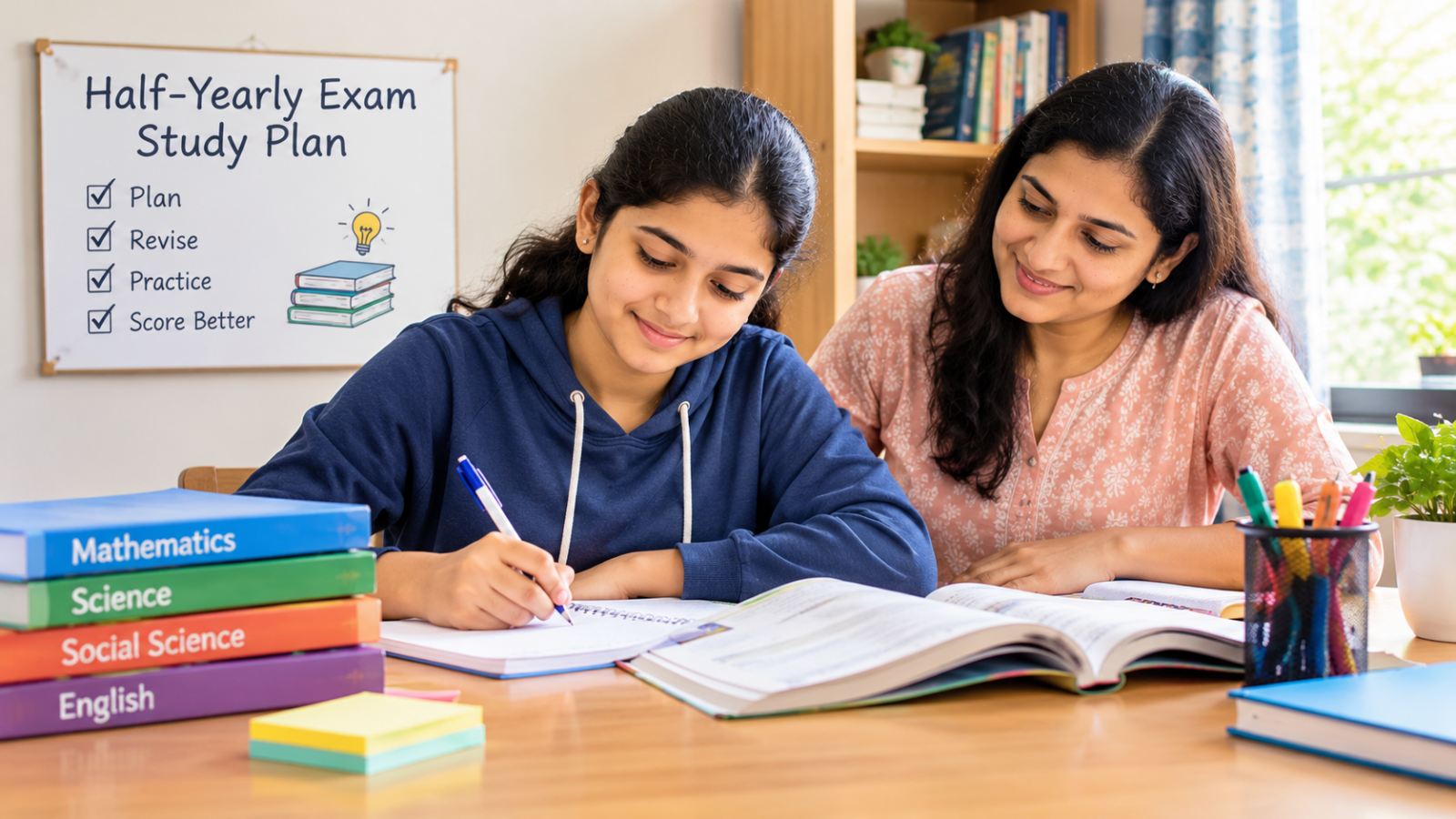
Quick answer: The best half-yearly exams preparation plan starts with your school's syllabus, divides chapters into manageable daily targets, and leaves enough time for revision and practice tests. You do not need to study all day; you need a realistic timetable, regular practice and a clear idea of what to revise next.
Half-yearly exams are an important opportunity to check how well you understand the subjects taught during the first part of the academic year. Whether you are in Class 6, Class 8, Class 10 or Class 12, starting with a plan can help you use your time better and feel more confident before the exam.
Half-Yearly Exams Preparation: Start with a Syllabus Checklist
Before making a timetable, find out exactly what you need to study. Ask your teachers for the confirmed syllabus, note the exam dates and check whether your school has shared a paper pattern or revision worksheet. Do not assume that every chapter in your textbook will be included.
Make a separate checklist for every subject. Divide chapters into three categories:
- Confident: You understand the chapter and can answer questions without looking at your notes.
- Needs revision: You understand the main ideas but forget facts, formulas or steps.
- Needs attention: You struggle to explain concepts or solve questions independently.
Start with topics that need attention, but continue revising the ones you already know. This prevents you from spending all your time on one difficult chapter while forgetting everything else.
Create a Practical Daily Study Timetable
A useful study timetable balances school, homework, revision, practice and rest. The right number of study hours depends on your class, school schedule and how much syllabus remains. Begin with a routine you can follow consistently instead of copying someone else's long timetable.
Here is an example for a student who has school during the day. Adjust the timings to suit your own routine.
Study session | Suggested time | What to do |
|---|---|---|
Session 1 | 45 minutes | Revise a difficult topic in Maths or Science. |
Short break | 10 minutes | Stretch, drink water or rest your eyes. |
Session 2 | 45 minutes | Practise written answers or solve questions. |
Short break | 10 minutes | Take a screen-free break. |
Session 3 | 30–45 minutes | Revise a language, Social Science or another subject. |
Quick recap | 15 minutes | Recall key points and plan tomorrow's targets. |
These are sample timings, not a compulsory daily target. Younger students may need shorter sessions, while older students may need additional time for problem-solving and written practice. Keep some flexibility for homework, school tests and difficult chapters.
Make a 14-Day Half-Yearly Exam Study Plan
If your exams are about two weeks away, use this plan as a starting point. If you have more time, spread the work over additional days rather than rushing through the chapters.
Days | Main focus | Daily target |
|---|---|---|
Days 1–2 | Planning and assessment | Check the syllabus, list weak topics and organise notes. |
Days 3–6 | Concept revision | Revise priority chapters and complete textbook exercises. |
Days 7–9 | Practice and correction | Solve questions, write answers and revisit mistakes. |
Days 10–11 | Remaining topics | Finish pending syllabus and review key definitions and formulas. |
Days 12–13 | Mock tests and revision | Attempt timed practice papers and analyse errors. |
Day 14 | Light final revision | Review short notes, prepare exam materials and sleep on time. |
Important: Do not leave an entire subject until the final days. Include a small amount of revision for multiple subjects throughout the plan so that earlier chapters remain fresh.
Subject-Wise Tips for Half-Yearly Exams
Mathematics
Read the concept, review solved examples and then attempt questions without looking at the solution. Practise a mixture of easy and challenging problems, and maintain a mistake notebook for incorrect calculations or misunderstood steps.
- Learn formulas by understanding where and how to use them.
- Show working steps clearly instead of writing only the final answer.
- Redo incorrect questions after a gap to check whether you have understood the method.
Science
Focus on understanding concepts rather than memorising entire paragraphs. Revise definitions, diagrams, scientific terms, formulas and numerical problems according to your class syllabus. After reading a topic, close the book and explain it in your own words.
Social Science
Organise History, Geography, Civics and Economics separately. Use timelines, maps, comparison tables and short chapter summaries to remember information. Practise writing answers in clear points and include relevant examples when appropriate.
English and other languages
Revise prose, poetry, grammar and writing formats included in your syllabus. Practise comprehension and written answers within a reasonable time. Pay attention to spelling, sentence structure, presentation and the specific formats taught by your school.
Use Active Revision Instead of Just Rereading
Reading a chapter repeatedly can feel productive, but it does not always show whether you can remember the information independently. Active revision helps you test your understanding before the exam.
- Close-book recall: Read a section, close the book and write down its main points.
- Question practice: Answer textbook exercises and teacher-provided worksheets.
- Teach-back method: Explain a difficult concept aloud as if you were teaching another student.
- Spaced revision: Revisit important material after a gap rather than studying it only once.
- Error review: Keep a list of mistakes and review it every few days.
For CBSE students, use the textbooks and resources recommended by your school. You can also explore official learning and curriculum resources on the NCERT website. Check that any additional practice material matches your current syllabus and class.
How Parents Can Help During Exam Preparation
Parents can make revision easier by helping children organise their work and providing a calm place to study. Ask what the child plans to complete that day rather than repeatedly asking how many hours they have studied.
- Help create a visible checklist of subjects and chapters.
- Provide the books, stationery and other materials needed for revision.
- Encourage the child to ask questions when a concept is unclear.
- Keep reasonable breaks, meals, physical activity and sleep in the routine.
- Discuss mistakes calmly and focus on how to improve next time.
If a student repeatedly struggles with a subject despite regular effort, extra guidance may help identify gaps in understanding. Parents can find a tutor for their child's class and subject or browse tutor profiles to compare suitable options. A tutor should support independent learning, not simply complete homework for the student.
Common Study Mistakes to Avoid
- Starting without a plan: Write down the syllabus and exam dates before choosing daily targets.
- Ignoring weak subjects: Give difficult topics regular attention instead of avoiding them.
- Making unrealistic timetables: Leave time for school, homework, breaks and sleep.
- Only reading notes: Include written answers, numerical problems and self-tests.
- Studying new material all night: Protect sleep, particularly before an exam.
- Comparing progress with friends: Measure progress against your own checklist and previous mistakes.
The Night Before and the Morning of the Exam
The day before an exam should focus on consolidation, not panic. Review your short notes, formulas, definitions, maps and commonly missed points. Avoid trying to learn the entire syllabus from scratch overnight.
Pack the materials permitted by your school, confirm the reporting time and prepare your uniform or clothes in advance. Get adequate sleep and eat a familiar breakfast. In the exam hall, read the instructions carefully, manage your time and leave a few minutes to review your answers if possible.
Frequently asked questions
How many hours should I study for half-yearly exams?
There is no single number that works for every student. Plan focused sessions around your school schedule, syllabus and learning needs. The quality of revision and regular question practice matter more than sitting at a desk for long hours.
How can I prepare for half-yearly exams in 7 days?
List the confirmed syllabus, prioritise weak and important topics, and divide your available time across subjects. Practise questions daily and review mistakes. Keep the final day for light revision rather than starting several large chapters at once.
Which subject should I study first?
Start with a subject or topic that needs focused attention while you are alert. Alternate demanding subjects with lighter revision to keep your routine manageable. Make sure every subject receives time before the exam.
Should I solve sample papers for half-yearly exams?
Yes, if suitable papers or worksheets are available from your teacher or school. They can help you practise timing, question interpretation and written answers. Check that the material follows your school's syllabus and paper pattern.
What should I do if I cannot understand a chapter?
Break the chapter into smaller concepts, review the basic examples and attempt a few simple questions first. Ask your teacher, parent or tutor to explain the exact step that is confusing. After understanding it, solve a similar question independently.
How can parents reduce exam stress?
Help children follow realistic daily targets, take regular breaks and maintain healthy sleep habits. Listen to their concerns without making marks the only measure of success. If stress becomes persistent or significantly affects daily life, consider seeking appropriate professional support.